How long does it take a website to rank on Google? Real data and timelines
Ranking a website on Google isn’t about luck, it’s about timelines and strategy. The data is clear: 72.9% of pages in the top 10 are over 3 years old. But that doesn’t mean you have to wait a decade. In this article, I explain the real timelines, what factors speed them up, and how to shorten them with a measurable strategy.
Published on · 9 min read
The question everyone asks me before signing a project is always the same: «Alex, how long will this take to work?»
The honest answer is: it depends. But I’m not going to leave you with «it depends» and call it a day. There is data, there are studies, and there is a real range I can give you. What I can assure you is that if someone promises you the first position in a month, they’re lying.
Quick answer: A new website usually starts seeing tangible results (traffic and conversions) between 6 and 12 months. A website with authority can notice improvements in 3-6 months if the work is technical and on-page. 40.82% of pages that reach the top 10 do so in their first month, but only 1.74% of new pages achieve it within a year.
The reality of the data: Google rewards age
Before getting into strategies, I want you to see the real picture. According to Ahrefs’ study of 1.3 million keywords, 72.9% of pages occupying the top 10 are over 3 years old.
The average page occupying the number 1 position is 5 years old. In 2017, it was only 2 years. The bar has been raised.
Does this mean a new website has no chance? No. It means competing for generic, high-volume terms is a long-term battle. But there’s a hopeful data point: 40.82% of pages that reach the top 10 do so in their first month. How? By targeting low-competition terms and with impeccable technical execution.
The 5 factors that most influence the timeline
Not all websites take the same time. These are the variables that, in my experience, make the difference between seeing results in 3 months or in 12.
1. Domain authority (DA/DR)
A website that already has history and quality backlinks starts with an advantage. Google already «trusts» it. A new website needs to build that trust from scratch. If your project is new, link building isn’t optional, it’s the accelerator.
2. Your niche competition
Ranking for «lawyer in Valencia» isn’t the same as «best running shoes». In local and long-tail niches, timelines shorten drastically. In transactional sectors with giants like Amazon, it’s a different story.
3. Technical quality and speed
Google needs to crawl and index your site without friction. If you have indexing errors, misconfigured redirects, or lousy loading speed (check your Core Web Vitals), you’re wasting time before you even start. A technically clean site gets indexed faster and better.
4. Content: generic or with E-E-A-T?
If you write the 500th article about «what is SEO», you won’t rank. If you write an article with your real experience, screenshots of your projects, and data nobody else has, Google and AI will pay attention. It’s the difference between content and content that ranks and converts.
5. Architecture and internal linking
An orphan page takes forever to be crawled. A content plan with a silo structure and coherent internal links makes Google discover your important pages in days, not months.
Real timelines by website type
To give you an idea, this is the range I handle in my projects:
| Website type | First signs of improvement | Tangible results (traffic/leads) |
|---|---|---|
| New website (no authority) | 2-3 months (indexing and first long tails) | 6-12 months |
| Website with history (3+ years) | 2-4 weeks (if work is technical) | 3-6 months |
| Ecommerce | 1-3 months (categories) | 6-9 months (product pages and categories) |
| Local business (Local SEO) | 1-2 months (Google Business Profile) | 3-6 months |
Note: these timelines are for ranking and generating traffic. If we’re talking about dethroning the number 1 for a highly competitive keyword, we could be talking about years.
How to speed up ranking (without magic)
There are no shortcuts, but there are levers that make the process much faster. In my experience, these work best:
- Start with the technical side: A technical SEO audit will tell you exactly what’s blocking Google. Fixing that is step one.
- Target long-tail first: Low-competition keywords rank faster (sometimes in weeks). That gives you early traffic and tells Google your site is relevant.
- Update existing content: Sometimes you don’t need to create anything new. Updating an article that already has impressions but no clicks can skyrocket your traffic in days.
- Get quality backlinks: Not hundreds of junk links. A few editorial links from relevant websites in your niche can move the needle more than you think. If you want to know how to do it right, check my link building guide.
Real case: from 0 to +200% in 6 months
So you don’t just get theory, let me tell you what happened with one of my clients. This is TQIVCA, a training course business that came from a rebrand and had an old website with no traffic.
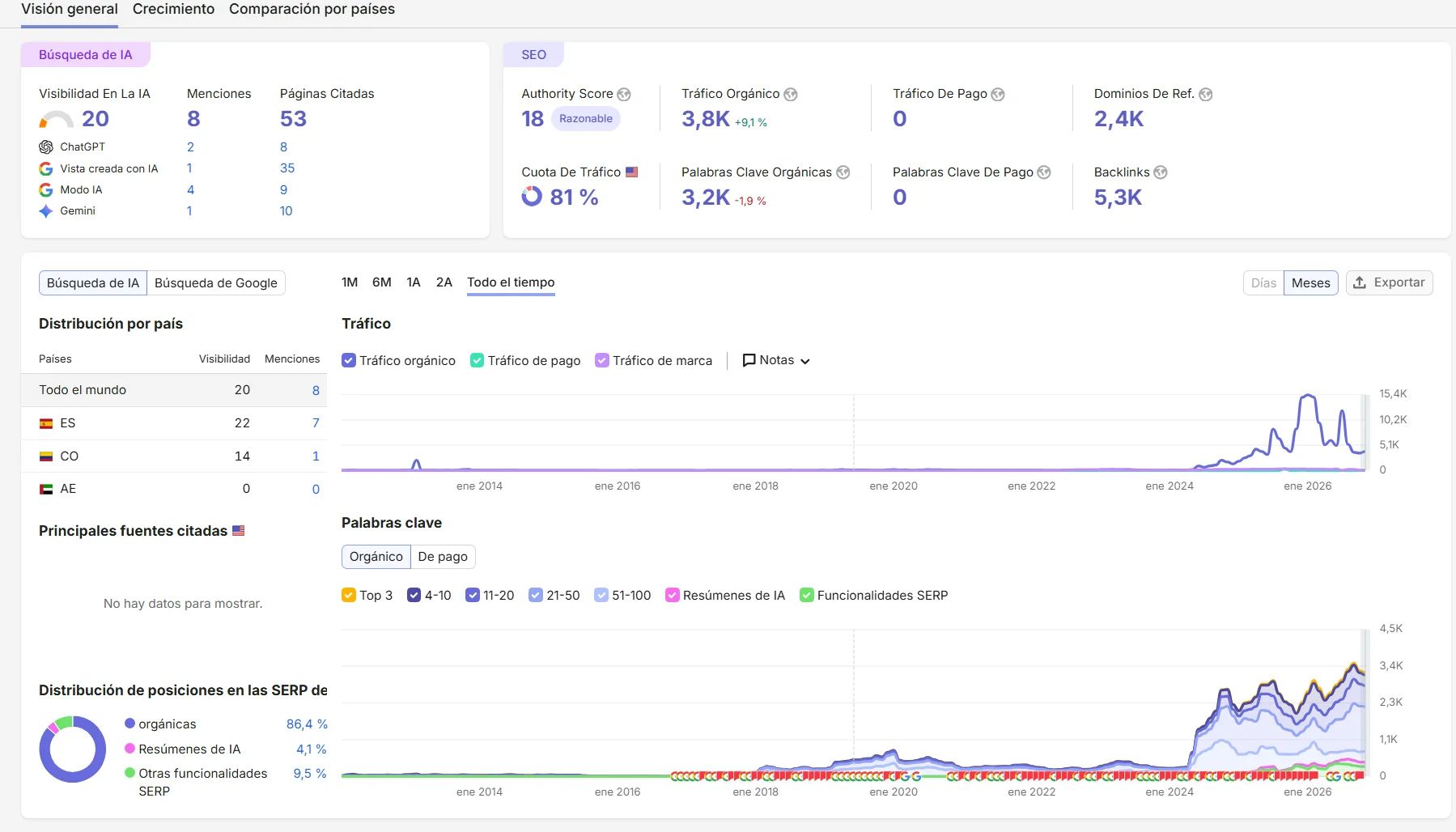
We started from zero (or almost). In 6 months, we multiplied their organic traffic by more than 3 across four different markets. How did we do it?
- First, we fixed the redirects and indexing that had broken with the rebrand.
- Second, we did on-page per country (we didn’t translate, we localized).
- Third, we used the courses’ own syllabus as content. It was information the competition didn’t have, and Google (and users) valued it highly.
It wasn’t magic. It was strategy, execution, and not wasting time on things that don’t move the needle. If you want to see the full breakdown, it’s in the TQIVCA case study.
And it’s not the only case. With Llumm Studios (llumm.com), we secured a high-quality editorial link on a specialized medium that brought them three potential clients in the first week. With Aire Comprimido Valencia (airecomprimidovalencia.com), we adjusted local rankings and shortened timelines because we targeted long-tail keywords in a very specific niche.
Frequently asked questions about ranking timelines
Can you rank a website in 1 month?
Yes, for very low-competition and long-tail terms. For keywords with real volume and competition, it’s practically impossible. Anyone who promises you the number 1 in a month is selling you smoke.
Why doesn’t my website appear on Google after 3 months?
It could be for several reasons: indexing errors (check Search Console), content that’s too generic, lack of internal links, or a website architecture that doesn’t facilitate crawling. A technical audit is the first step to get out of the rut.
How long does Google take to index a new page?
Normally, between a few days and a couple of weeks if the page has internal links pointing to it. If it’s orphaned (no links), it can take months or never get indexed. Use the «URL Inspection» tool in Search Console to request indexing manually.
Does older content rank better than new content?
The data says older pages tend to rank better. But that’s not because of age itself, but because they’ve had time to accumulate links, user signals, and updates. A new page with a solid strategy can compete perfectly well.
How does Google’s AI (AI Overviews) affect timelines?
AI Overviews is changing the way Google displays information, but not indexing timelines. What it does do is give generic content even fewer opportunities. To stand out, your content must provide real experience (E-E-A-T) and data that AI can’t generate on its own.
Want to know how long your project might take? Every website is different. If you want a realistic estimate (no smoke), you can check out my SEO consulting services or contact me directly. I’ll tell you what you need and how long it might take.

Do you need to rank your website?
If you want to stop wasting time and start seeing measurable results, let’s talk.