How I got +200% organic traffic for a VCA course business a real case study
We started almost from scratch: an old website, a half-done rebrand and competition in four languages and four markets. In 6 months, we multiplied organic traffic by more than 3 with a technical audit, on-page per country, content from the company’s own syllabus, link building and Google Ads in parallel.
Published on · Updated on · 9 min read
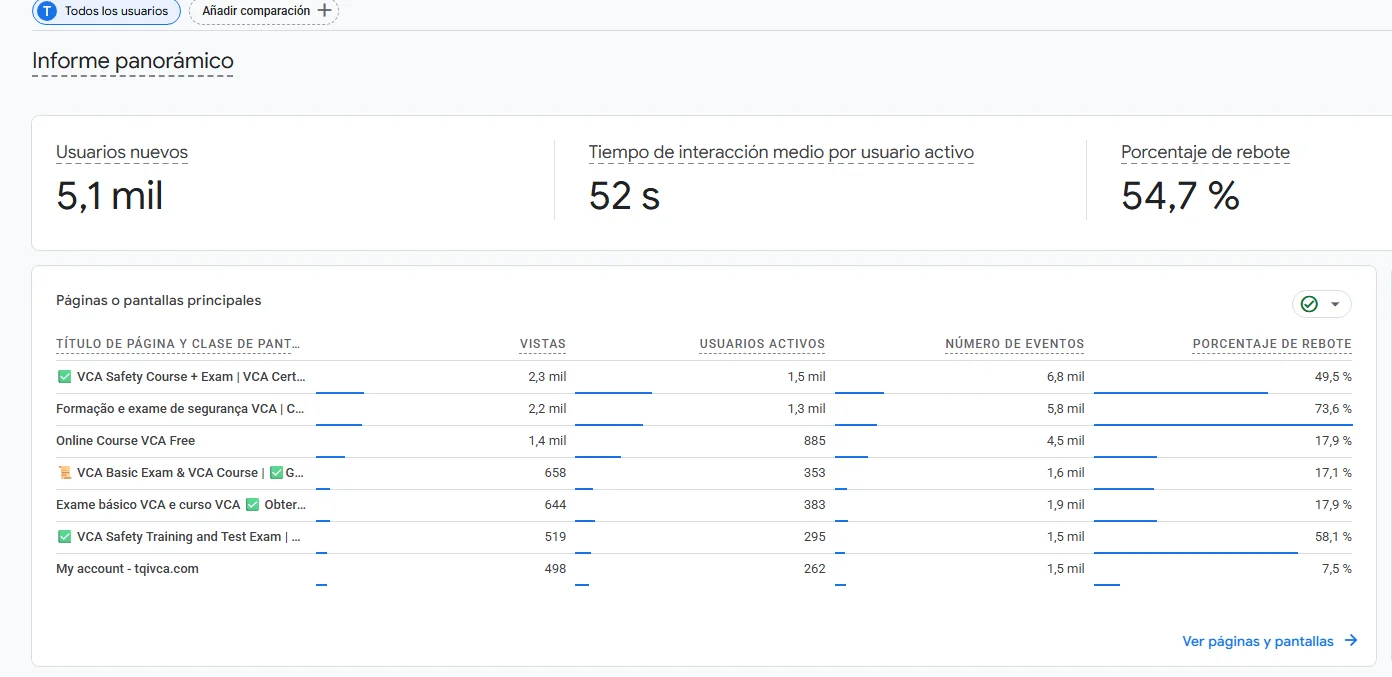
Every case study I show on my website has a story behind it. This is one of the most satisfying, because we started almost from scratch and the industry was far from simple: technical workplace safety training, with competition in four languages and four different markets.
I’ll tell you exactly what we did, in what order and why, so you can apply the same logic to your business if you’re in a similar situation. If you’re starting from scratch, begin with what SEO is and how it works.
The starting point: a website with no traffic and a half-done rebrand
The client is TQIVCA, a private company specialized in VCA and VCA VOL courses (workplace safety certifications in high demand in industrial and construction sectors). They offer training in Spanish, Portuguese, Dutch and French, which already complicates any strategy: it’s not one market, it’s four.
The company came from a rebrand: it used to be called Internationaltqi, and that name change had left an old website, with no traffic and no positioning strategy behind it. Basically, invisible on Google and Google Maps in all four languages and countries where they wanted to sell.
The goal was clear: start generating qualified visits and real enrolments within a reasonable timeframe. We gave ourselves 6 months.
Step 1: Technical audit
Before touching a single word of content, we did a complete technical SEO audit in 7 steps. With a recent rebrand in play, it was almost certain there were inherited errors, and there were:
- Misconfigured redirects from the old domain (Internationaltqi) to the new one.
- Indexing errors: important pages blocked or not indexed.
- Poor loading speed, especially on translated versions of pages. Here we also reviewed the Core Web Vitals: what they are and how to improve them.
- Lack of a proper multilingual structure (hreflang tags misimplemented or missing), critical when you work in four languages and Google needs to know which version to show each user based on their country and language.
If your project comes from a domain change, also check out this guide to HTTP 404, 301 codes and web errors that block Google so you don’t lose signals along the way.
Step 2: On-Page SEO focused on each country and each language
With the technical side resolved, it was time for on-page optimization. Here the key was not treating the four markets as one.
We worked country-specific keywords, for example:
- «VCA course Spain» / «VCA VOL course Spain»
- «VCA course Portugal»
- «VCA VOL course Netherlands» (in its Dutch version)
- «VCA training France»
Each course page was optimized with its own metadata; meta title, meta description and content in the corresponding language, avoiding the typical mistake of literally translating the Spanish content into the other languages. If you want to dive deeper, here’s how to optimize the meta title and meta description and how to choose keywords wisely.
Search intent isn’t identical in every country, so we also adjusted the texts based on how each market actually searched. All of this is part of the complete On-Page SEO guide.
Step 3: Practical content based on the course syllabi
This was, for me, the key piece of the whole project and what differentiated this strategy from generic on-page optimization.
Instead of writing generic blog articles about «what workplace safety is» (which already exist by the thousands), we went chapter by chapter through each VCA and VCA VOL course and turned each topic block into a practical, standalone article. For example:
- Specific risks depending on the type of industry.
- Safety regulations applicable in each country.
- Example exam questions solved and explained.
- Differences between VCA and VCA VOL certification, and which one each professional profile needs.
What happened then?
- It captured real informational searches from people already interested in training, not passing visits.
- It was impossible for the competition to copy, because it came directly from the company’s own syllabus. Nobody else could offer that level of detail with the same authority.
This content approach connects directly with the principles of E-E-A-T: experience, authority and trust on Google, and with the logic of an SEO content plan in 5 steps that starts from the business’s own knowledge.
Step 4: Off-Page SEO to gain domain authority
With quality content published, we started building authority. In an industry as specific as workplace safety training, there aren’t as many link opportunities as in more generalist niches, so we prioritized quality over quantity:
- Mentions and links from training and employment portals related to the industrial sector.
- Collaborations with blogs specialized in workplace risk prevention.
- Relevant industry directories in each country (Spain, Portugal, Netherlands and France).
If you want to replicate this part, check out the guide on Off-Page SEO and link building: strategies that work.
Step 5: Accelerating the process with Google Ads
SEO needs time to mature, and with a recent rebrand we couldn’t afford to wait six months without any kind of visibility. That’s why, in parallel with all the organic work, we launched Google Ads campaigns with a tight budget.
The purpose of these campaigns wasn’t to replace SEO, but to:
- Generate enrolments while organic ranking gained strength.
- Quickly validate which keywords converted best in each country, information we then used to prioritize organic content.
- Maintain brand visibility after the name change, when people could still search for the old name.
The result: +200% organic traffic in 6 months
Combining these four phases in order (never the other way around), TQIVCA went from a website with barely any visits to multiplying its organic traffic by more than 3 across all four markets it operates in, within a 6-month timeframe.
The most important thing wasn’t just the traffic figure, but that this traffic arrived already segmented by country and language, to specific course pages, with content that answered exactly what those people needed to know before enrolling.
Key figures: +200% organic traffic · ×3 across all four markets · 6 months of execution · 4 languages (Spanish, Portuguese, Dutch, French).
What to learn from this case if you have a similar business
If you have a business that sells training, courses or certifications in several countries or languages, these are the lessons I take from this project:
Fix the technical side first
No content or link can compensate for a badly indexed website or one without correct hreflang.
Don’t translate, localize
Each country searches differently, even if it speaks the same language.
Use your own knowledge as content
If you have a syllabus, a process or an experience nobody else has, that’s your most profitable content in SEO.
Combine SEO with Ads while organic matures
Especially if you come from a rebrand or a website with no history.
Do you have a multilingual or multi-market project? This type of strategy can be replicated if you start from a good SEO audit and a content plan that uses the business’s real knowledge as a competitive advantage. Tell me about your case and I’ll reply in less than 48 hours.

Want results like these in your business?
I work on multilingual and multi-market SEO strategies with your own content that the competition can’t copy.