SEO vs SEM: what’s the difference and which should you choose for your business?
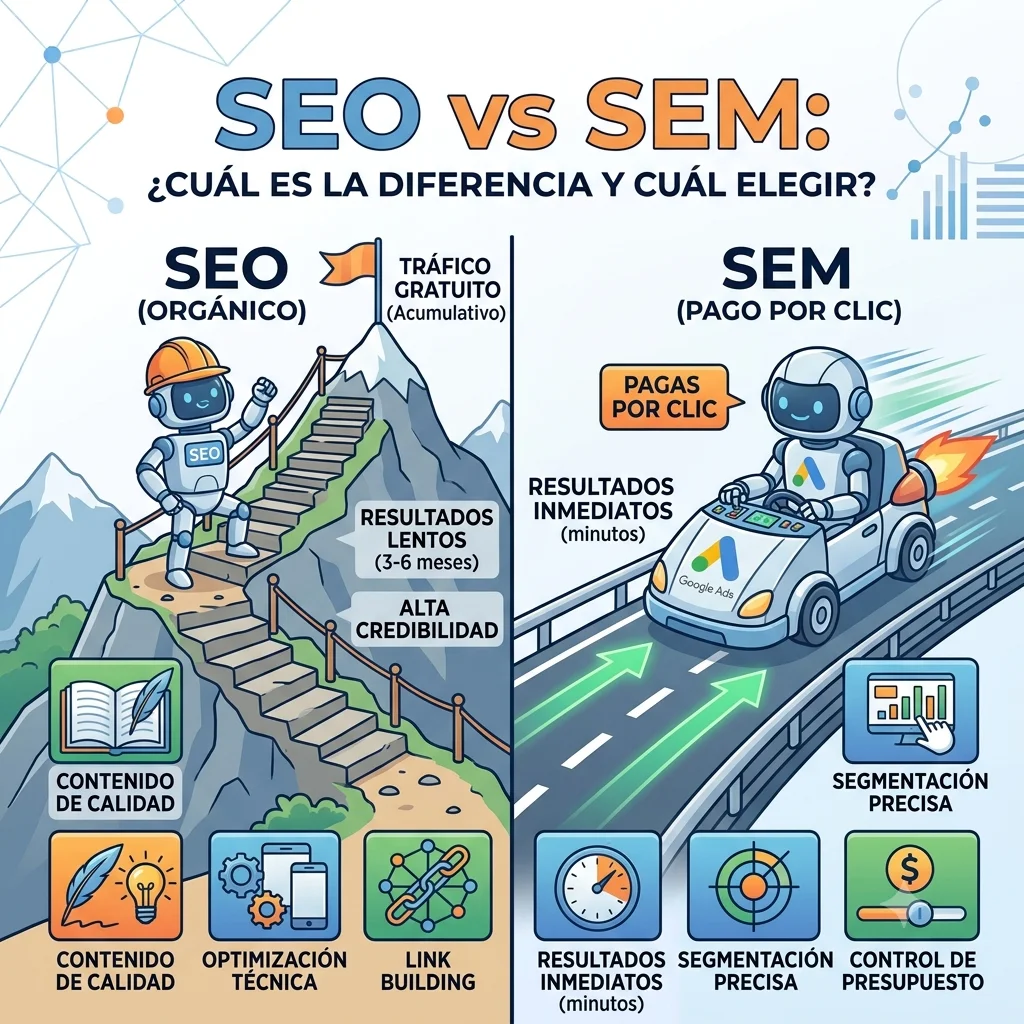
Comparative infographic between SEO and SEM: SEO offers free traffic, long-term results, high credibility and requires quality content, technical optimization and link building. SEM offers pay-per-click, immediate results, precise targeting and budget control.
Published · Updated · 11 min read
When a business needs visibility on Google, the first question is usually: SEO or SEM? Which is the better investment? Which will give me faster results? Which is more profitable?
The answer isn’t simple, but in this article I’ll explain what each strategy is, their key differences and when to choose one or the other based on your budget, goals and the stage of your business.
What is SEO?
SEO stands for Search Engine Optimization. It’s the set of techniques that improve a website’s organic ranking in Google results. If you want the full detail, see my guide on what SEO is and how it works.
How is SEO done?
- Quality content: articles, guides and pages that answer user questions. Learn to choose keywords wisely.
- Technical optimization: loading speed, URL structure, structured data, indexing. This is where On-Page SEO and Core Web Vitals: what they are and how to improve them come into play.
- Link building: earning quality links from other relevant websites. I explain it in Off-Page SEO and link building: strategies that work.
- User experience: design, navigation, mobile usability.
Advantages of SEO
- ✅ Free traffic (you don’t pay per click)
- ✅ Long-lasting results (traffic accumulates over time)
- ✅ Credibility and trust: users trust organic results more than ads.
- ✅ High return on investment (ROI) long term.
Disadvantages of SEO
- ❌ Slow results: minimum 3-6 months to see improvements.
- ❌ Ongoing investment: requires updates and maintenance.
- ❌ No guaranteed ranking: algorithm changes can affect it.
What is SEM?
SEM stands for Search Engine Marketing. It’s the paid advertising strategy on search engines, mainly through Google Ads.
How is SEM done?
- Google Ads: pay-per-click (PPC) campaigns.
- Targeting: by location, language, interests, schedule.
- Budget control: you decide how much to spend per day.
- Ads: they appear at the top (marked as «Ad»).
Advantages of SEM
- ✅ Immediate results (in minutes/hours).
- ✅ Full budget control.
- ✅ Precise targeting: you reach your target audience.
- ✅ Ideal for promotions and launches.
- ✅ You measure ROI exactly.
Disadvantages of SEM
- ❌ You pay per click (cumulative cost).
- ❌ When you stop the investment, results disappear.
- ❌ Can be expensive on competitive keywords.
- ❌ Lower credibility: many users ignore ads.
SEO vs SEM: Direct Comparison
| Aspect | SEO | SEM |
|---|---|---|
| Time to results | 3-6 months (or more) | Immediate (minutes) |
| Cost | Investment in time/resources | Pay per click (CPC) |
| Traffic duration | Cumulative and long-lasting | While you pay |
| Credibility | High (organic results) | Medium (ads) |
| Click-Through Rate (CTR) | 30-40% (top positions) | 2-5% (ads) |
| Positioning control | Limited (depends on algorithm) | Total (you pay to appear) |
| Long-term investment | Excellent | Depends on budget |
If you want to improve your CTR in organic results, I explain how to improve the click-through rate on Google.
When to choose SEO?
SEO is the best option if your business fits one of these profiles:
You have a limited budget but time available
SEO requires investment in time and resources, but you don’t pay per visit. If you have a team or can dedicate time to creating content, it’s the most profitable long-term strategy.
You want to build authority and credibility
Organic results build more trust than ads. A business that appears in the top positions of Google is perceived as more reliable and established, reinforcing the E-E-A-T: experience, authority and trust on Google.
Your business is a niche with evergreen content
If you sell services or products that don’t expire quickly, SEO lets you accumulate traffic month after month without the need to invest in constant advertising.
You have a long-term strategy (more than 12 months)
SEO is an investment that pays off over time. If you plan to be in the market for years, it’s the best decision. A good starting point is to do a complete SEO audit in 7 steps.
When to choose SEM?
SEM is the best option if your business fits one of these profiles:
You need immediate results
If you’ve just launched your business or a new product and need visits now, SEM is the only option. Ads start generating traffic the same day.
You have budget for advertising investment
SEM requires a daily or monthly budget. If you can invest without affecting your profitability, it’s an excellent tool.
You want to test the market before investing in SEO
With SEM you can test which keywords, messages and offers work before committing to a long-term content strategy. It helps you choose keywords with real data.
You have one-off promotions or launches
SEM is ideal for temporary campaigns: Black Friday, sales, new product launches, events.
What if I combine SEO and SEM?
This is the strategy I recommend to most of my clients. When you combine SEO and SEM, you get the best of both worlds:
Hybrid strategy
- Use SEM for immediate results while SEO matures.
- Invest in SEO to build a sustainable long-term traffic base.
- Use SEM for highly competitive keywords where SEO would take too long to rank.
- Reinforce SEO with SEM data: the keywords that convert best in ads are excellent candidates for SEO content.
Practical example
A fashion ecommerce store:
- Launches SEM campaigns for new collections and promotions.
- Works on SEO for categories and style guides.
- In 6-12 months, SEO generates constant traffic and reduces dependence on SEM.
Tip: if you’re going to combine both strategies, make sure you work well on SEO copywriting vs standard writing and correctly implemented Schema to maximize impact.
Conclusion: which should you choose?
| Your situation | Recommendation |
|---|---|
| Limited budget, time available | ✅ SEO |
| You need immediate results | ✅ SEM |
| You want to build a brand long term | ✅ SEO |
| You have one-off promotions | ✅ SEM |
| You can invest in both | ✅ SEO + SEM |
| Your website is new and has no authority | ✅ SEM first, SEO later |
If you don’t know where to start, check out the free SEO tools in 2026 I use daily to audit any project.

Need help defining your strategy?
Not all businesses need the same thing. Some need SEO from day one, others need SEM to get started, and most benefit from a smart combination of both.