How to improve your CTR on Google a practical guide for 2026
8 proven strategies to increase clicks in search engines: optimize titles and meta descriptions, use rich snippets, run A/B tests and analyze your data in Search Console. No empty theory.
Published on · Updated on · 11 min read
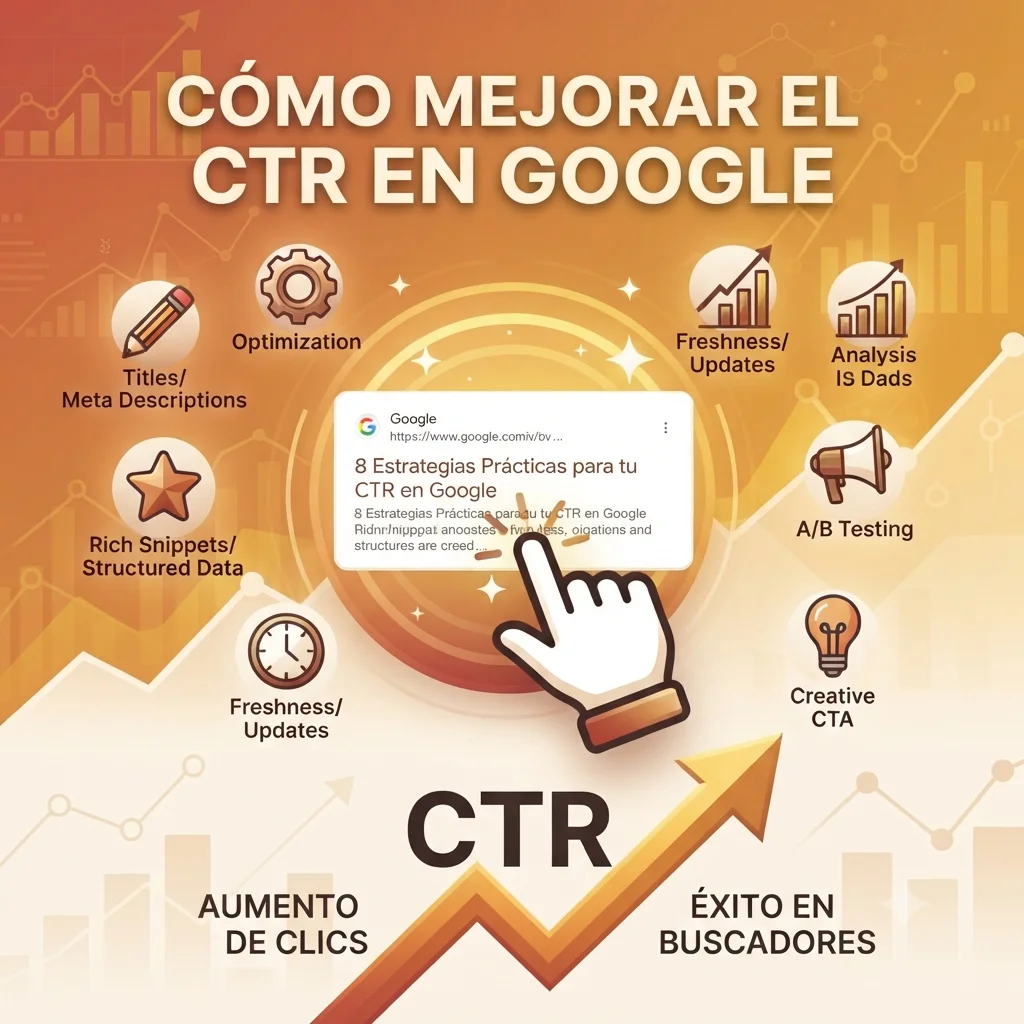
Okay, let’s talk straight. You have great content, your keywords are well chosen, but traffic isn’t coming. You look at Google Search Console and see that your pages appear in the results, but people aren’t clicking.
The problem isn’t your content. It’s your business card in the SERP.
CTR (click-through rate) is that metric that measures how many people who see your result decide to click on it. And you’d be surprised how much it influences your ranking. Google interprets that if your result attracts many clicks, it’s because it’s relevant to users. And if it’s relevant, it deserves to climb positions.
In this guide I’m going to give you 8 practical and proven strategies to improve your CTR. No empty theory. Only what works. If you’re starting from scratch, begin with what SEO is and how it works.
What is CTR and why should it matter to you?
CTR (Click-Through Rate) is the percentage of clicks you get divided by the number of impressions. The formula is simple:
CTR = (Clicks ÷ Impressions) × 100
If your page is shown 1,000 times and gets 20 clicks, your CTR is 2%.
And why does that matter? Because Google uses CTR as a quality signal. When your result appears in a position and people click on it, the algorithm interprets that your content is relevant for that search. That’s why improving CTR is one of the most direct ways to climb positions without needing to build more links or create more content.
All this is part of On-Page SEO, the foundation for ranking any page.
What is a good CTR? (and why there’s no magic number)
I’m not going to fool you with a universal number. A good CTR depends on your industry, your niche and the type of search.
| Google position | Reference CTR |
|---|---|
| First position | 27% – 35% |
| Second position | ≈ 15% |
| Overall organic average | 2% – 5% |
But beware: this varies enormously. In sectors like technology or finance, CTR tends to be lower because search intent is more complex and users are more cautious. In ecommerce or travel, CTR tends to be higher because the user wants to see products or experiences.
The best reference isn’t your industry average, but your own historical data. If your CTR is improving month over month, you’re on the right track.
8 strategies to improve your pages’ CTR
Now let’s get to the important part: the 8 strategies you can apply today to increase clicks on your search results.
Optimize the Title Tag
It’s the first thing the user sees. And often, the only thing. Place the main keyword at the beginning, include numbers or specific data, use adjectives that spark curiosity and add the year to convey freshness. Here’s how to optimize the meta title and meta description.
Write compelling meta descriptions
The meta description doesn’t directly influence ranking, but it’s the text that convinces the user to click. Be clear and direct, include a benefit or value, and avoid starting with negatives. Good SEO copywriting makes all the difference.
Use structured data to get Rich Snippets
Rich snippets (stars, prices, dates, FAQs) make your result stand out visually in the SERP. The most useful schemas for CTR are AggregateRating, Product and FAQPage. Here’s the complete list of schemas and how to check that your schema works.
Harness the power of keywords in the URL
The URL also appears in the SERP. It’s not the most important factor, but it helps. Include the main keyword in the URL and keep it short and descriptive. If you need to choose keywords wisely, here’s how to choose keywords.
Run A/B tests with titles and descriptions
The best way to know what works is to test it. Select a group of pages, change only the title (or only the description) and compare the results in Google Search Console. Change only one variable at a time.
Timing matters: update old content
Google values freshness. If you have old content, update the publication date and review the title and description to reflect that it’s fresh content. It’s the same logic I apply when I do a complete SEO audit.
Loading speed matters (even if you don’t think so)
Speed doesn’t directly influence SERP CTR, but it does affect bounce rate and perceived quality. Here’s the complete Core Web Vitals guide and, specifically, how to improve LCP.
Analyze and act with Google Search Console
This is the most important tool for improving CTR. It shows you exactly which pages have low CTR and for which keywords. Filter by pages or queries, sort by CTR from lowest to highest, and prioritize pages with many impressions but few clicks.
Common mistakes that kill your CTR
There are four mistakes that repeat over and over and are sinking your CTR without you realizing it:
- Misleading titles or clickbait: you get clicks, but the bounce rate skyrockets. Google detects it and penalizes it.
- Excessive keyword optimization: forcing the keyword into the title in a repetitive, unnatural way.
- Ignoring mobile users: if your title or description gets cut off on mobile, you lose clicks.
- Not updating old content: Google prefers fresh content. If you don’t update it, your CTR can drop.
If you want to avoid more common mistakes, review this list of SEO web mistakes and how to avoid them.
Frequently asked questions about CTR
Does CTR directly influence rankings?
It’s not a direct ranking factor, but it’s a relevance signal. If your result gets many clicks, Google interprets that it’s useful and it can improve your position.
What’s a good CTR for SEO?
It depends. In general, between 2% and 5% is a good starting point for organic results. But if you’re in the first position, it should normally be above 20%.
How do I know if my CTR is low?
Compare your data with the page’s historical data. If you see it has dropped in the last months, something has changed. You can also compare it with the average CTR of your industry, but keep in mind that every niche is its own world.
What tools can I use to measure CTR?
Google Search Console is the best. It gives you accurate data on clicks, impressions and CTR. Google Analytics also helps, but GSC is the source of truth.
And remember: if your CTR goes up, your ranking can follow. It’s not magic. It’s Google rewarding relevance. Applying these principles also reinforces your E-E-A-T: experience, authority and trust on Google, and if you want to see a real case, check out how I got organic traffic on VCA.
If you’d rather have a professional optimize your CTR for you, I help you analyze your Search Console data, prioritize pages and improve titles, descriptions and snippets. Tell me about your case and I’ll reply in less than 48 hours.

Want more clicks from Google?
I analyze your real data and propose a CTR optimization plan tailored to your site.