What is a Keyword and how to choose the right keywords for your website
Infographic on what a keyword is, types by search intent (informational, commercial, transactional, navigational) and a 4-step selection process: think like your customer, analyze competitors, use research tools and filter.
Published · Updated · 11 min read
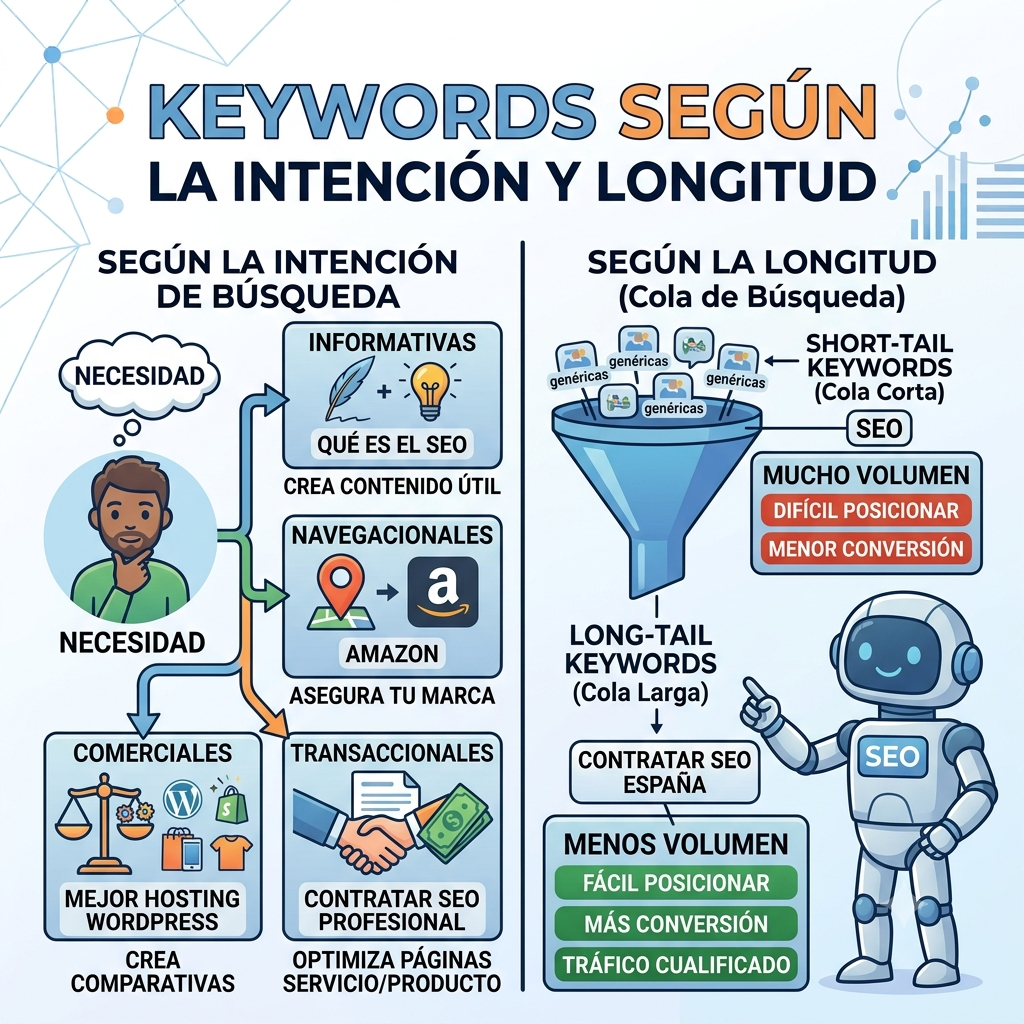
Keywords are the terms users type online to find what they’re looking for. Choosing the right words is the first step to get your website to appear in search results.
Difference between short tail and long tail
| Type | Example | Volume | Competition | Intent |
|---|---|---|---|---|
| Short tail | «shoes» | High | Very high | General / unclear |
| Long tail | «brown dress shoes size 42» | Low | Low | Very specific |
Why are they so important?
Because keywords connect what people search for with what you offer. If you choose the right keywords and optimize your content for them, Google will understand your website is relevant and show it in the first results.
If you choose poorly, your website won’t appear and you’ll lose business opportunities. That simple. If you’re starting from scratch, begin with what SEO is and how it works.
Types of keywords you should know
1. Keywords by search intent
Informational
The user just wants to learn or solve a doubt. They’re not ready to buy.
- «what is SEO»
- «how does digital marketing work»
- «why isn’t my website showing on Google»
Strategy: create useful content that answers these questions. That’s how you start building trust and authority.
Navigational
The user is looking for a specific website or brand.
- «Facebook»
- «Amazon»
- «Alex Figueiras SEO»
Commercial
The user is researching before buying, but hasn’t decided yet.
- «best hosting for WordPress»
- «SEO vs SEM: which to choose«
- «alternatives to Shopify»
Transactional
The user is ready to buy or hire.
- «hire professional SEO»
- «buy gaming laptop»
- «online digital marketing course»
2. By length
Short-tail keywords
These are short, generic and highly competitive keywords.
- «SEO»
- «shoes»
- «marketing»
Advantage: high search volume.
Disadvantage: very hard to rank and not always qualified traffic.
Long-tail keywords
These are longer, more specific phrases with less competition.
- «hire SEO services in Spain»
- «cheap leather shoes for men»
- «how to do digital marketing for small businesses»
Advantage: less competition, easier to rank and more qualified traffic.
Disadvantage: less search volume, but higher conversion rate.
How to choose keywords for your business
Step 1: Think like your customer
Put yourself in your ideal customer’s shoes and ask:
- What would I search on Google if I needed this product or service?
- How would my customer describe my business?
- What questions do they ask before buying?
Step 2: Analyze your competitors
Go to your competitors’ websites and look at:
- What keywords do they use in their titles and descriptions?
- What blog posts do they have?
- What terms do they use in their categories and tags?
Step 3: Use keyword research tools
You don’t have to guess what people search for. Use these free and paid tools:
Step 4: Filter and prioritize your keywords
Not all the words you find are worth it. To decide which to use, ask yourself:
- Does it have search volume? (if nobody searches for it, it’s useless)
- Is it relevant to my business? (will it attract potential customers)
- How much competition does it have? (can I rank in the first results?)
- Does it have buying intent? (is the user ready to buy or just researching?)
Keyword research tools
| Tool | Type | Ideal for |
|---|---|---|
| Google Keyword Planner | Free | Getting started and checking search volume |
| Ubersuggest | Freemium | Beginners and small businesses |
| AnswerThePublic | Free | Finding user questions |
| SEMrush | Paid | Advanced analysis and competitor research |
| Ahrefs | Paid | Professionals and agencies |
Practical example for your business
Let’s apply all of this to a real case. Imagine you have a digital marketing agency in Barcelona.
Bad keywords
- «marketing» → too generic
- «advertising» → not specific
- «digital marketing» → too competitive
Good keywords
| Keyword | Why it’s good |
|---|---|
| «digital marketing agency Barcelona» | Specific, local and with hiring intent |
| «SEO for small businesses Barcelona» | Clear niche with real demand |
| «how to do digital marketing for my business» | Long-tail and solves a need |
| «hire an SEO specialist» | High buying intent |
How to use keywords on your website
Once you have your keyword list, it’s time to place them on your website.
Key places to include your keywords:
- Titles (H1, H2, H3): learn the H1, H2 and H3 hierarchy.
- Meta title and meta description: how to optimize meta title and meta description.
- Page URL or slug.
- First paragraph of content.
- Images (alt attribute).
- Internal links (anchor text): key within On-Page SEO.
- Structured data (Schema Markup): that’s how you can check that Schema is working.
Common mistakes when choosing keywords
- ❌ Choosing only generic words: «SEO», «marketing», «sales» → impossible to rank if you’re starting out.
- ❌ Ignoring search intent: attracting traffic that won’t buy is useless. With the arrival of AI, understanding search intent in AI Mode is even more important.
- ❌ Not analyzing the competition: there may be keywords that seem perfect but have very strong competitors.
- ❌ Not updating the strategy: SEO is dynamic. Review your keywords every 3-6 months, especially if you work with an SEO content plan in 5 steps.
If you want to dig deeper into the most frequent mistakes, check out SEO mistakes and how to avoid them.
Free tools for keyword research
If you don’t want to invest money at first, these tools are perfect:
Google Keyword Planner
Search volume and suggestions directly from Google.
AnswerThePublic
The questions people ask around a topic.
Ubersuggest
Keyword suggestions and ranking difficulty.
Keyword Surfer
Chrome extension with search data inside Google.
Google Trends
Search trends and temporal evolution.
And if you want more, I have a complete compilation of free SEO tools in 2026.
Final tip: review your keywords every 3-6 months as part of a complete SEO audit in 7 steps to make sure you’re still targeting the right searches.

Need help choosing your keywords?
If you want to define the keyword strategy for your business and don’t know where to start, let’s talk.