Off-Page SEO and Link Building: strategies to gain authority in 2026
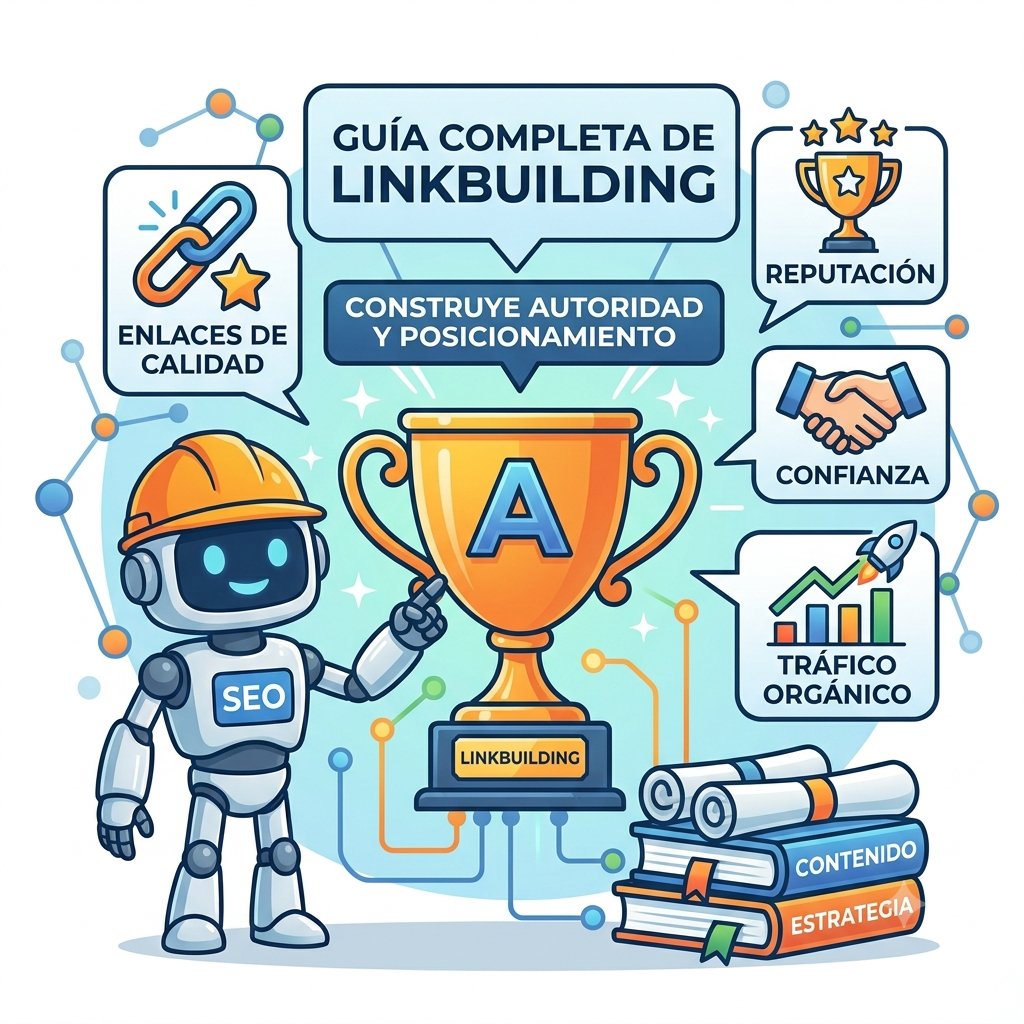
Complete Link Building guide covering the key concepts: authority building, web ranking, quality backlinks, trust, organic traffic and SEO strategy. Everything you need to gain domain authority without risking penalties.
Published · Updated · 11 min read
Having a technically perfect website with excellent content is only half of the SEO journey. The other half is outside your website: in the links other sites dedicate to you, in your brand mentions and in the digital reputation you build online.
In this article I explain what Off-Page SEO is, why Link Building remains one of the most important ranking factors and which strategies work in 2026 to gain authority without risking penalties. If you’re starting from scratch, begin with what SEO is and how it works.
What is Off-Page SEO?
Off-Page SEO covers all the actions you take outside your own website to improve its ranking on Google. While On-Page SEO works within your website (content, tags, speed, structure), Off-Page SEO works in the digital environment: links, mentions, social networks, reviews and presence on other sites.
Why is it so important?
Google uses Off-Page SEO to measure the authority, relevance and trust of your domain. When other websites link to you or talk about you, Google interprets that your content is valuable and deserves to appear in the top results.
In other words: Off-Page SEO is the vote of confidence that other sites give you on the internet.
What is Link Building?
Link Building is the process of earning quality external links (backlinks) that point to your website. It’s the most important part of Off-Page SEO and one of the factors that carries the most weight in Google’s algorithm.
A backlink is basically a link from another website to yours. Every link counts as a «vote» of confidence. But not all votes are worth the same:
- A link from a high-authority digital newspaper is worth a lot.
- A link from a blog with no visits or authority is worth almost nothing.
- A link from a questionable website can penalize you.
Quality matters more than quantity
Google has evolved and today values the quality of links much more than their quantity. It’s better to have 10 links from relevant, authoritative websites than 1,000 links from junk directories or link farms.
Key factors of Off-Page SEO
SEO works across three dimensions that complement each other. Within Off-Page, these are the factors that matter most:
1. Domain Authority (DA)
Domain Authority is a metric that predicts how well a website will rank in search results. It’s measured on a scale from 0 to 100 and calculated from the quantity and quality of incoming links. Higher authority = higher ranking capacity.
2. E-E-A-T strategy
Google evaluates four pillars to decide whether it trusts your content:
- Experience: do you have real experience on the topic?
- Expertise: are you a recognized expert?
- Authority: do other sites cite and recommend you?
- Trustworthiness: are you reliable and transparent?
Link Building directly contributes to building authority and trust. I explain it in detail in E-E-A-T: experience, authority and trust on Google.
3. Link relevance
A link from a site related to your industry has far more value than one from an unrelated site.
For example, if you run a digital marketing agency, a link from a marketing blog is worth more than one from a cooking blog.
4. Anchor text
The anchor text is the visible text that contains the link. Google uses it to understand what the target page is about. It’s important that anchor texts are varied and natural:
- ✅ «SEO agency in Spain»
- ✅ «hire digital marketing services»
- ✅ «click here» (only occasionally)
If you want to dive deeper into how to choose the right words for your anchor texts, check out how to choose keywords wisely.
5. Link variety
A natural link profile includes a combination of:
- Links from different types of sites (blogs, media, directories)
- Links with different anchor texts
- Dofollow and nofollow links
- Links from different domains (not all from the same site)
Link Building strategies that work in 2026
These are the strategies I recommend to my clients and that I’ve found actually work.
1. Guest posting on authoritative blogs
Writing guest articles on relevant blogs in your industry remains one of the most effective strategies.
How to do it:
- Identify blogs in your industry with good authority.
- Propose a valuable, original topic.
- Write a quality article (not covert advertising).
- Include a natural link to your website in the bio or within the content.
Tip: don’t just target any blog. Target blogs that actually have an audience and reputation.
2. Link reclamation
When someone mentions your brand or product on their site but doesn’t link to you, you can reach out and ask them to add the link.
How to do it:
- Use tools like Ahrefs or Google Alerts to find mentions of your brand.
- Contact the author and thank them for the mention.
- Politely ask them to add a link to your website.
3. Linkable assets
Create content so good that other sites want to link to it naturally. This type of content is key within a SEO and GEO content strategy that ranks and converts.
Examples of linkable assets:
- Complete, up-to-date guides
- Original infographics
- Case studies with real data
- Free tools (like the ones on your website)
- Statistics and original data
4. Broken link building
Find broken links on other websites and offer your content as a replacement.
How to do it:
- Use tools like Ahrefs or Check My Links to find broken links.
- Identify what content those links previously pointed to.
- Create similar content on your website.
- Contact the site owner and offer your content as an alternative.
5. Digital PR and media relations
Getting mentions in digital media and newspapers is one of the most powerful ways to build authority.
How to do it:
- Create journalistic content (studies, surveys, original data).
- Contact journalists and editors in your industry.
- Offer statements, interviews or exclusive data.
6. Collaborations and interviews
Take part in podcasts, webinars and interviews with other professionals in your industry.
Benefits:
- You position yourself as an expert.
- You earn links from the hosts’ websites.
- You expand your network.
What NOT to do in Link Building
| Practice | Risk |
|---|---|
| Buying links | Manual or algorithmic penalty |
| Link farms | Backlink disavowal |
| Junk directories | No value, possible penalty |
| Spam comment links | Google ignores or penalizes them |
| Too many links with the same anchor text | Looks artificial and can penalize |
Google rewards naturalness. A link profile with a mix of types, sources and anchor texts is far more valuable than one with 100 identical links from low-quality sites.
Metrics to measure your progress
| Metric | Description | Tool |
|---|---|---|
| Domain Authority (DA) | Domain authority | Ahrefs, Moz |
| Number of referring domains | How many domains link to you | Ahrefs, SEMrush |
| Link authority | Quality of the sites linking to you | Ahrefs, SEMrush |
| Dofollow/nofollow ratio | Natural balance between both | Ahrefs, SEMrush |
| Anchor text diversity | Variety of anchor texts | Ahrefs, SEMrush |
You can complement these metrics with the free SEO tools in 2026 I use daily to audit link profiles.
Conclusion
Off-Page SEO and Link Building are two essential pillars for your website to gain the authority it needs to rank on Google. Without quality links, no matter how much content you have, it’ll be hard to compete.
In 2026, authority also matters beyond Google: it also influences whether you appear in how to appear on ChatGPT with your business and other AI engines. Building authority with a solid GEO strategy for AI is the best long-term investment.
If you want to start with a complete diagnosis of your link profile and your current authority, I recommend doing a complete SEO audit in 7 steps.

Want to gain authority and rank your website?
If you need a solid, risk-free link building strategy, let’s talk.