Local SEO: how to appear on Google Maps and near your customers
The Local Pack takes between 60% and 80% of the clicks from local searches. If you’re not there, you’re losing customers. I explain the complete system to rank your business on the map.
Published on · Updated on · 11 min read
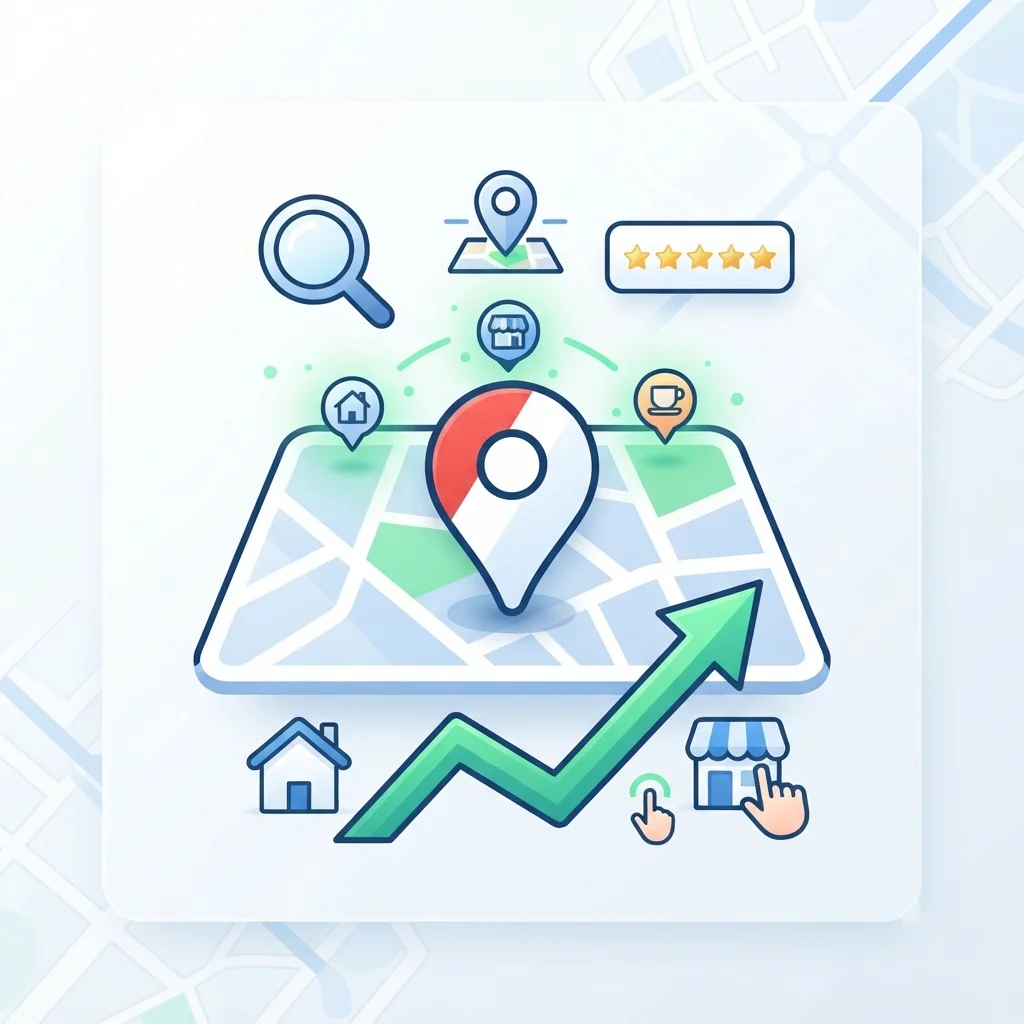
Local SEO is the strategy that connects your business with customers searching for your services in your area. When someone searches for «coffee shop near me» or «plumber in Madrid», Google shows a map with three featured businesses. It’s the famous Local Pack or «3-pack», and it takes between 60% and 80% of the clicks. If you’re not there, you’re losing customers.
The good news: local ranking can be worked on. It’s not luck. It’s applying a system based on three pillars that Google has made public: relevance, distance and prominence. If you’re starting from scratch, begin with what SEO is and how it works.
The three factors that determine your local ranking
Google uses these three factors to decide which businesses to show in the Local Pack:
| Factor | What it means | How you influence it |
|---|---|---|
| Relevance | How well your profile matches what the user is searching for | Use precise categories, local keywords and a detailed description |
| Distance | How close you are to the searching user | You can’t move your business, but you can define your service area well |
| Prominence | How well-known and trustworthy your business is | Positive reviews, links from other sites and activity on your profile |
Distance is fixed, but relevance and prominence are in your hands. And they’re the key to climbing positions.
Step 1: Optimize your Google Business Profile (it’s 36% of the work)
Your Google Business Profile listing is the most important asset for local SEO. According to industry studies, it influences up to 36% of local ranking.
What can’t be missing from your profile:
- Correct primary category. It’s the most powerful signal you give Google. Choose the most specific one possible. For example, «Hair transplant surgeon» is better than «Doctor».
- Consistent name, address and phone (NAP). They must be exactly the same on your profile, your website and all the directories where you appear. Google penalizes inconsistencies.
- Quality photos and videos. Profiles with images get 42% more direction requests. Upload at least 10 photos: exterior, interior, team and products.
- 750-character description. Use it to explain what you do, where and for whom. Include local keywords naturally, without forcing them.
A common mistake: don’t add keywords to your business name (e.g. «Pérez Plumbers – Plumbers in Madrid»). Google detects it and can suspend your profile.
Step 2: Manage reviews
Reviews are the second most important factor for local SEO, with a weight of 17%. It’s not just about having many. Speed also matters: how you earn new reviews.
What works:
- Ask for reviews at the right moment. Right after a satisfactory purchase or service.
- Respond to all of them. Both positive ones (thank them) and negative ones (apologize and offer a solution). Google values the response.
- Don’t buy fake reviews. Google removes them and can penalize you.
A business with more than 100 reviews gets up to 7 times more clicks than one with fewer than 10. It’s a virtuous circle. Here’s the complete guide on how to get more Google Business Profile reviews.
Step 3: Publish content regularly
Google rewards activity. Profiles that publish content weekly have better visibility than those that have gone months without updating.
What to publish:
- Special offers or promotions
- News (new services, team, hours)
- Useful tips related to your industry
- Local events or community involvement
Each post should include an image or video and a clear call to action: «Call us», «Book an appointment», «Visit us».
Step 4: Optimize your website for local searches
Your website and your Google Business Profile work together. Google cross-references the information from both to verify your legitimacy.
On your website:
- Create specific pages per location. If you work in several cities, each one should have its own page with unique content, not copied.
- Include your location in important texts. Naturally, without forcing it.
- Add visible contact details. Address, phone and map on every page.
- Loading speed. A slow site penalizes, including locally. Ensure decent Core Web Vitals. Here’s how to improve your Core Web Vitals.
A practical example: instead of «How to take care of your dental health», write «Most common dental problems in the Chamberí neighborhood and how to prevent them». That way you connect with your real area.
If your site runs on WordPress, remember that regular WordPress maintenance also matters, and if you want to complete your local strategy, check out the best free local SEO directories.
The Local Pack isn’t magic. It’s consistent work.
Local ranking isn’t fixed with a single change. It’s the sum of small adjustments and continuous maintenance:
- Review your Google Business Profile monthly
- Publish content every week
- Manage reviews daily
- Update your website with local content
Google wants to see that you’re a real, active and relevant business for your area. When you prove it, it rewards you with the Local Pack.
If you want a specialist to work on your local SEO, I audit your Google Business Profile listing, your reviews and your website, and give you a clear plan to enter (or climb) the Local Pack. Tell me about your project and I’ll reply in less than 48 hours.

Want to appear in the Local Pack of your city?
I work on local SEO for businesses that want to attract customers from their area through Google Maps and local searches.